Ann and Oliver begin an affair
The War of the RosesAnn and Oliver begin an affair in the strained household Oliver shares with Barbara. The encounter grows out of two unequal currents: Ann’s privately cultivated desire for Oliver and Oliver’s acute distress over his marriage. When the children leave for Boston, Ann seizes the prospect of being alone with him; later, as he speaks of anger, wounded pride, and loss, she offers physical comfort and initiates sex. Their intimacy gives way not to a simple romantic resolution but to questions about independence, gender, and the house that has become the focus of the Roses’ conflict.
Background and Secrecy
Ann’s attraction predates the affair. She knows her feelings for Oliver are unrequited, and the knowledge makes her cautious: she keeps herself in the role of observer while watching the Roses’ movements and interpreting their looks and stray words as signs of what might happen next. She reviews what she has seen at night, but also worries that they may notice her scrutiny. Her apparent indifference conceals both curiosity about the marriage and a personal hope that Oliver might see her as an alternative.
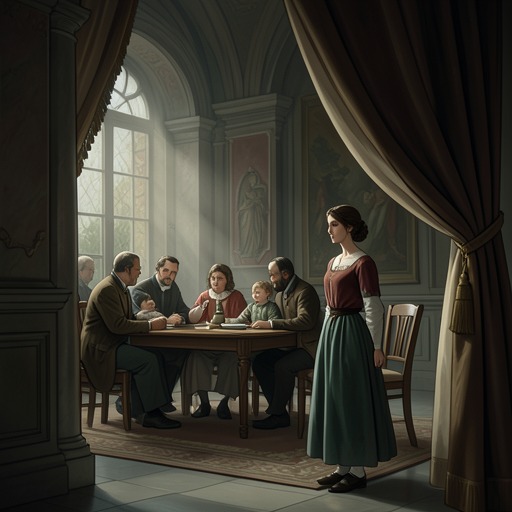
The separation has unsettled the whole household. When Eve first confides in Ann, she describes Barbara’s decision as a declaration of independence and says that her mother wants freedom to pursue her own aspirations rather than remain an appendage. Eve is shocked: she and her friends had believed her parents had an unusually good relationship, built around doing things together and sharing the house. Ann already knows the marriage has broken down, but the realization still brings guilt and disbelief. Her position is therefore complicated from the outset: she comforts the children and observes their parents’ hostility while privately desiring one of the people at its center.
The children’s departure for Boston creates the immediate opportunity. Ann helps them pack, writes down Barbara’s instructions about shopping and defrosting, and promises to feed Mercedes. At the door she embraces the departing family and performs the sadness of a caregiver saying goodbye. Once they are gone, however, she is elated at the prospect of being alone with Oliver. She hopes Barbara has not detected her feelings, though the concealment seems less important to her in that moment. Ann prepares herself for the possibility of intimacy, even while knowing that Oliver has given her no clear encouragement; after an earlier incident in the library on Christmas Eve, he had apologized.
Intimacy in a Household at War
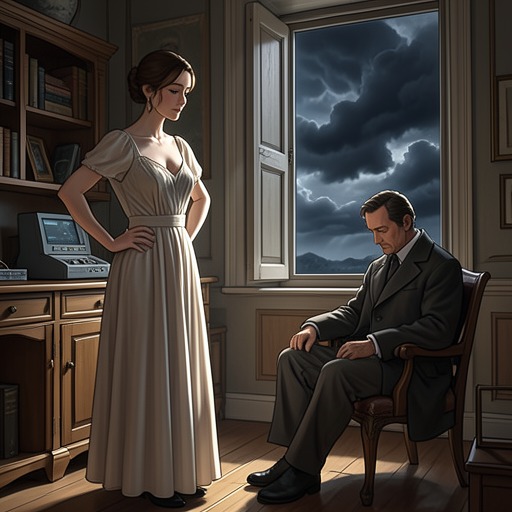
When Oliver talks with Ann, his attention is fixed on the divorce and the anger it has produced. He calls Barbara mean and directs his resentment in several directions: toward himself, toward his lawyer Goldstein, toward Barbara’s adviser Thurmont, and toward his children for not taking his side. Beneath that anger is self-reproach. He says that he is mostly angry with himself for not having been the person he believed himself to be, and describes his ego as dead. Ann tells him he is too hard on himself. As his eyes mist, she moves toward him, embraces his head, and kisses his hair.
Ann’s response is at once caretaking and erotic. She tries to soothe Oliver, then opens her robe and offers herself to him. He is shaking with sobs as she urges him to cry and touches him; she undresses him and kneels to kiss him. His response is immediate, but the scene does not present the encounter as uncomplicated seduction: Oliver apologizes, and afterward the two lie close together, scarcely moving, while Ann listens to his heartbeat. He thanks her. The progression joins grief to sexual desire, with Ann acting both as comforter and as a woman seeking intimacy she has wanted for some time.
Oliver then takes Ann upstairs to the room he has occupied since moving out of the shared bedroom. Its disorder gives a concrete measure of his present disarray: papers and files cover the available surfaces, unwashed dishes sit on a commode, a hot plate rests on a desk, and liquor bottles are scattered around. Ann embraces him again, hoping to comfort him, but he turns instead to a Staffordshire figure of Queen Victoria. He says it is a forgery bought in Atlantic City and that he keeps it to remind himself of his own stupidity. Even in this private encounter, the objects and disordered room connect Oliver’s emotional injury to the material world he associates with his life and marriage.
Independence and Unequal Expectations
After thanking Ann for what she gives to the children and to him, Oliver praises her as a gift. Ann resists being defined only by what she provides: she tells him she is not merely giving but taking as well. His response—that she sounds like Barbara—makes her recognize a distance between them. Ann has acquired a sense of independence and equality, and she sees that Oliver belongs to a different generation, with a different understanding of women. Her moment of insight also produces an unexpected sense of alliance with Barbara: the wish not to be dependent is not exclusive to the wife Oliver resents.
Their conversation makes that disagreement explicit. Oliver mourns the loss of the protector’s role, while Ann rejects the idea that men should remain lords and masters. When Oliver says he no longer knows whether he can believe what a woman tells him or shows him, Ann replies that women have been conditioned to suppress secrets; he answers that men have secrets too. They then make love again, slowly and tenderly. Unlike the earlier encounter, Oliver does not take the initiative away from her, and afterward they lie side by side with their fingers locked together. The change in pace suggests greater reciprocity within this encounter, though it does not erase the difference in their expectations or repair Oliver’s distrust.
The House and the Limits of the Affair
Afterward, Ann asks why Oliver is fighting so fiercely for the house when the family has already split apart. To her, it is a thing that could be sold and divided; she suggests splitting its value. Oliver insists that it is his whole world and that he will not let Barbara take that world with her. He says he is willing to give her half its value, while invoking his own labor and money. Ann answers that the house is part of Barbara’s world too and cannot be shared as before. Their exchange shows that the affair takes place inside, rather than outside, the Roses’ domestic conflict: Ann can offer Oliver comfort, but she also recognizes the claim the house holds for Barbara.
The beginning of the relationship is consequently marked by intimacy without resolution. Ann’s desire becomes physical, and Oliver accepts her care while he is vulnerable; later tenderness gives the encounter a measure of mutuality. Yet Oliver remains consumed by the marriage, the house, and his anger at himself and others. Ann, meanwhile, sees in his response to her independence an echo of the very conflict that has driven Barbara away. The affair starts not as an escape from the divorce but as a private bond formed within its emotional and material wreckage.